The Cost That Grows Every Time Your Marketing Works
In micro-drama you can measure almost everything. This is the one real cost that isn't on the dashboard, and it grows with every user you buy.


Micro-drama might be the most data-driven business in entertainment.
“Vertical storytelling, and all these apps […], live daily on the data,” said Buzz Leer, founder of The Vertical Buzz (opens in a new tab) podcast at the Micro Drama Summit last week.
(Not running a micro-drama app? Stay with me, this is the same cost reality every streaming platform experiences. Vertical just rides it fastest.)
You know your Return on Ad Spend (ROAS) by heart, and check it once a day (if not multiple times). You know your Customer Acquisition Cost (CAC), per-title ROI and cohort retention rates by campaign, by geo, by creative. The whole business runs on a dashboard.
However, there’s one real cost that never makes it onto that dashboard. No campaign to optimize, no budget you set in January. And it grows in lockstep with the thing your marketing colleagues are working frantically to grow. Here’s where it hides.
Start with the two costs you actually manage. Production is one. A series runs somewhere between $150,000 and $300,000 to make (opens in a new tab), and here’s how you judge it: did the title earn back its budget or not. Once it’s made, it’s made. Every extra viewer is free return on money you already spent.
Marketing is the other one, and it’s an absolute beast. The numbers shared at MIP London (opens in a new tab) this year put marketing at as much as 90% of platform budgets. ReelShort reportedly spent $27M of a $30M month on user acquisition. Twenty-seven of thirty. So of course you watch that number like a hawk.
And it keeps getting hotter. SocialPeta counts over 930 micro-drama apps (opens in a new tab) actively advertising every month, up 22% in a year, each pushing out thousands of ad creatives every month.
Here’s the thing about production and marketing costs: they’re predictable because you manage them.
Video delivery doesn’t sit still. And it doesn’t announce itself.
Delivery is the cost of getting the videos onto phones. It’s hard to budget and it’s not a campaign. It’s a variable cost that scales with usage, and it lives on a line most operators file under “infrastructure” and never open. So let’s open it.
Someone presses play. Your CDN ships them the episode, edge server to phone, and bills you for the shipment. A two-minute vertical episode at a phone-friendly bitrate is maybe 35 to 40 megabytes. One viewer, one shipment. The second viewer doesn’t get a discount. They get their own full shipment, and so does viewer one hundred thousand. Every single play is the whole episode, sent again.
Now add how people actually watch this stuff. A film is one delivery. A micro-drama series is 60 to 100 episodes, and people binge dozens in a sitting, so one user can rack up more deliveries in a night than most platforms get from a viewer in a month. And on a drop, they don’t trickle in, they arrive all at once.
Put it together and you see why this cost is a problem that needs your attention. Delivery scales 1:1 with users and with engagement, the two things your whole company is working to push up. You improve your ROAS, so you pour more into user acquisition, so more users come in, so they binge more episodes, and delivery costs climb the entire time. Your success metric goes up in public. Delivery goes up in private.
And it’s about to matter more. Chi Odogwu, who hosts the Micro Drama Summit (opens in a new tab) and Vertical Film School (opens in a new tab), sees the industry’s next act in two moves: AI keeps collapsing what it costs to make a show; and growth shifts to emerging markets: where you win on volume, not on price. The backdrop: Owl & Co (opens in a new tab), who called vertical a third audiovisual language, pegs it at $150 billion outside China this year, up 42% in a year. Almost all of that is social feeds, not micro-drama apps; but that’s the size of the habit micro-drama is built on top of.
Let’s run this through the cost lens.
Production, your fixed cost, trends toward zero. Revenue per user trends down. Delivery shrinks with neither. Every new viewer still needs every episode shipped to their phone, whatever they paid to watch it. So delivery takes a bigger bite of every dollar you earn. That’s the business end of the squeeze.
The engineering end is quieter. Researchers from Synamedia, Sky, and Ozyegin University showed at last year’s Mile-High Video conference (opens in a new tab) that huge catalogs of short files, most never watched to the end, erode the caching CDNs rely on to keep delivery cheap. And AI is about to make those catalogs much bigger.
So just as delivery becomes a bigger slice of your economics, each shipment gets harder to do cheaply. The pressure builds from both ends.
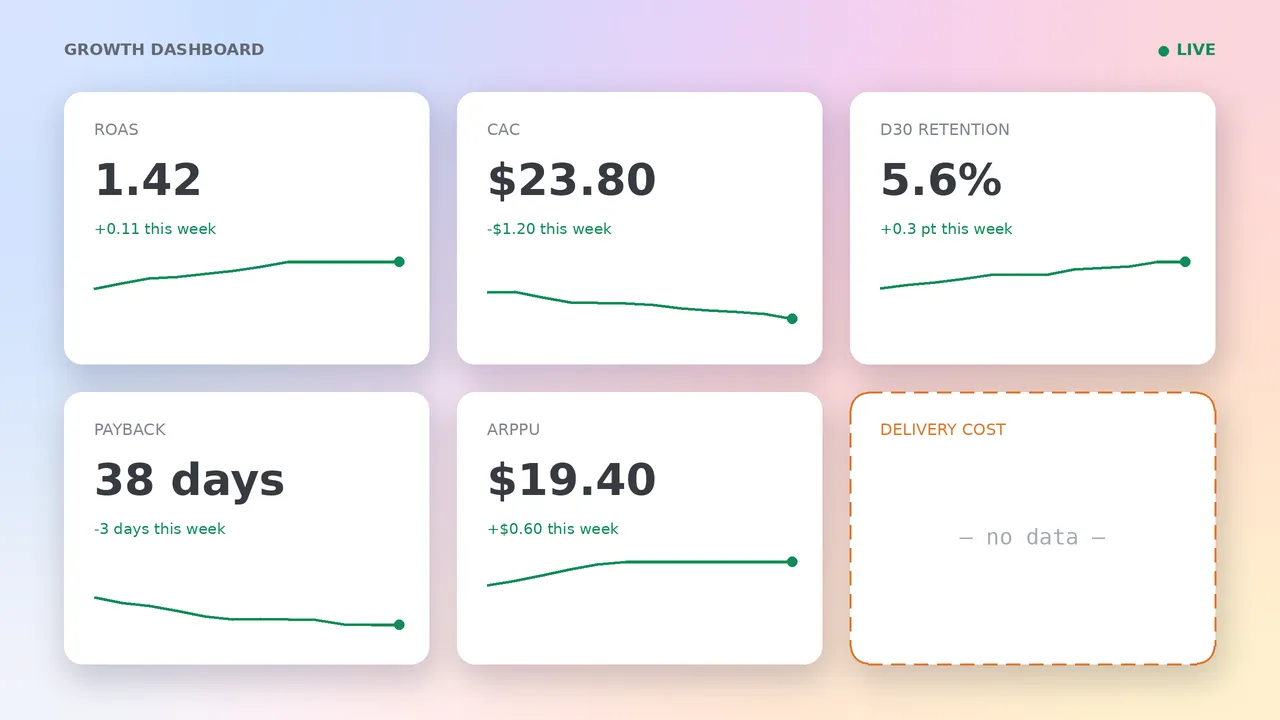
For today, just one move. You already track marketing as a share of revenue. Track delivery the same way: delivery cost as a percentage of revenue. Then, watch what it does as you scale acquisition. If it creeps up every time you push harder on growth, better to find out now than in next year’s business review. Put it on the dashboard with everything else. It costs nothing to track, and you could have it up by Friday.
(Full transparency: delivery is the corner of this I work on. Which is exactly why I wanted to write the version that’s just economics.)
If you want to sanity-check your own delivery-to-revenue number, message me on LinkedIn (opens in a new tab). Happy to walk through it with you.
Want to run the numbers on your own traffic?
Talk to our founders about your audience, delivery stack, and where peer-assisted delivery could help.