The Geographic Cost of a Global Audience
Why CDN pricing varies sharply by region, and how global audiences can reach new markets faster than delivery capacity and contracts can adapt.


For years, it was easy to forget that video delivery has a geography.
Content delivery network (CDN) prices kept falling and capacity kept expanding. As a result, the following assumption was easy to make: as video consumption grew, the cost of delivering each gigabyte would keep coming down.
That assumption is starting to break.
In Q2, Akamai introduced a 3% surcharge for customers, with price adjustments of up to 10% on contract renewals. Dan Rayburn (opens in a new tab), who has tracked the CDN market for two decades, says the broader trend is clear: don’t expect CDN delivery prices to keep declining. He expects them to tick up for most customers.
In my view, the bigger change isn’t only the headline price. It’s also the geography underneath it.
Rayburn’s latest look at the CDN market shows just how large the spread can be: delivery in South America averages 2.8× the North American price. Korea, where capacity is scarce and expensive, runs at roughly 10×. And CDNs are increasingly unwilling to build capacity in a market without a commitment that the traffic will come.
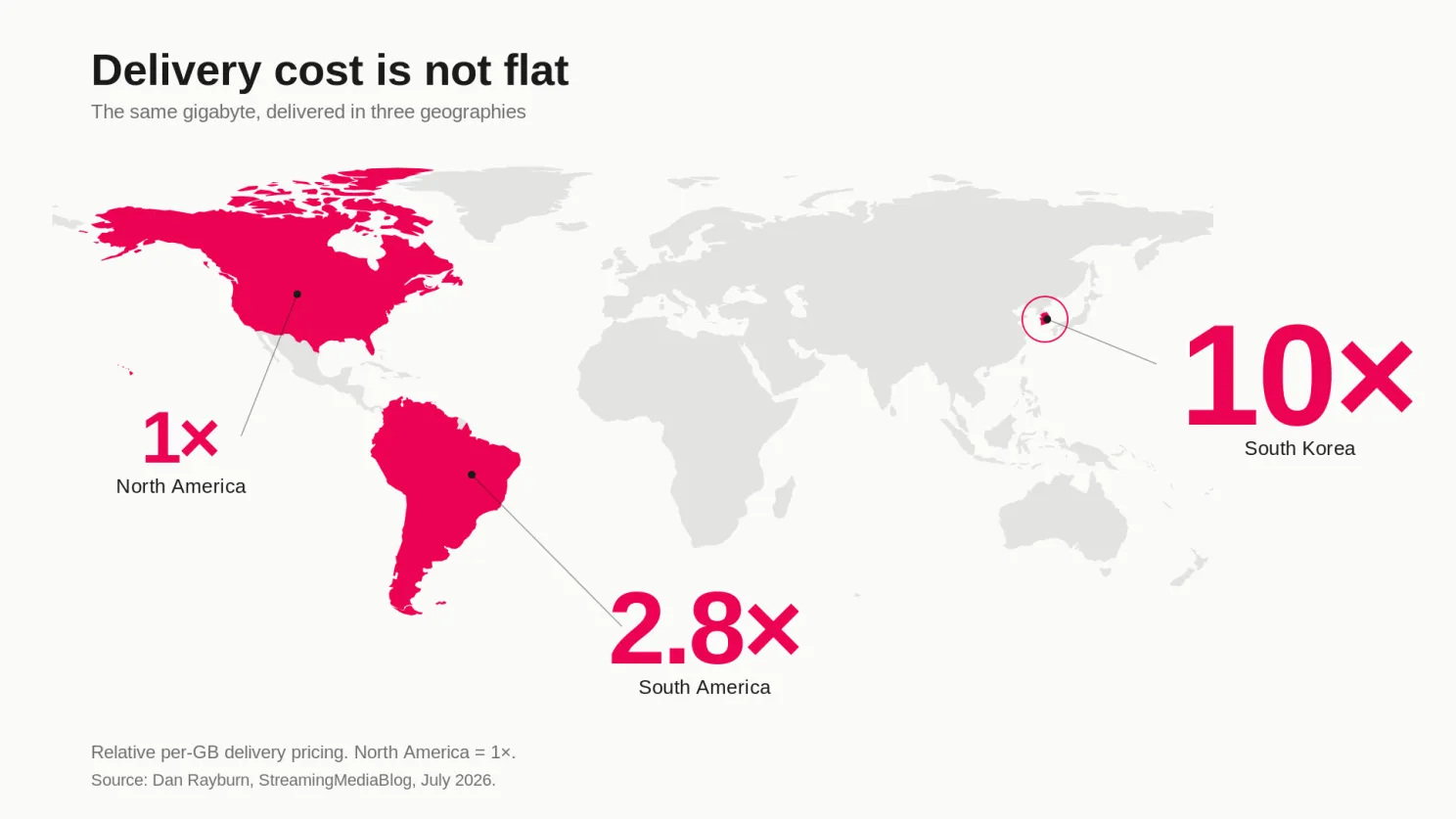
Read this as an operator. Your blended CDN rate hides a spread of ten to one. Each new market is delivered at that market’s economics, not your global average. And some of the markets where audience growth is desired are precisely the markets where delivery capacity can be most expensive and hardest to provision.
More specifically, a growth team might look at Brazil, Indonesia, India or Korea and see audience opportunities. However, an infrastructure team has to ask a different question: where will the traffic come from, how much capacity is available, and what will it cost to deliver to viewers in those geographies?
The audience moves faster than the infrastructure built to serve it. And it picks the geography. You don’t.
Even Netflix can’t always predict where an audience will emerge. Squid Game was picked up by Netflix’s Korean team as a local title and became a global phenomenon. Asked what makes a show break out worldwide, Ted Sarandos said: “You know when it’s happening. It’s a little hard to predict.”
Most titles won’t become Squid Game. But an everyday version of this happens constantly: a title over-indexes in a market you didn’t plan for, and the delivery bill follows it there at that region’s rate (1×, 2.8×, or 10×). The audience chose the geography.
Growth is planned by market. Delivery cost compounds by region.
The geography of growth
Micro-drama makes this particularly visible.
A title can break out in one country and, almost immediately, start generating significant viewing somewhere the team wasn’t planning around six months earlier. That’s because discovery happens globally, while infrastructure still has to be planned region by region.
The delivery decision therefore arrives after the audience signal.
The infrastructure commitment often has to arrive before it.
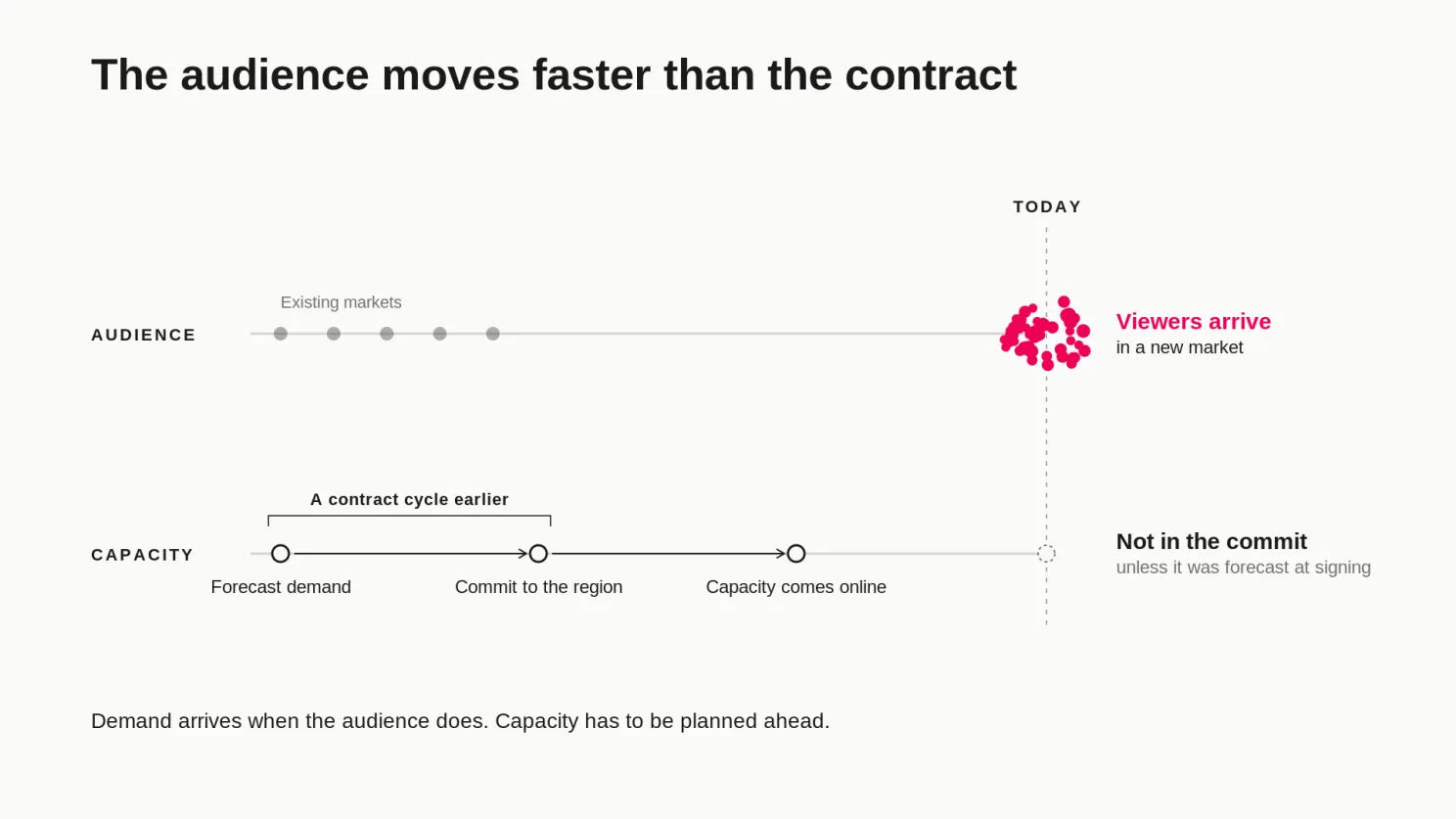
You can commit capacity per region, spread traffic across CDNs or negotiate different rates for different markets. All of those approaches have the same underlying constraint: you’re provisioning infrastructure based on where you expect the audience to be.
That works well when demand is relatively predictable and capacity keeps getting cheaper. It becomes harder when audiences can appear anywhere, quickly.
There is one source of delivery capacity that never has to be provisioned ahead of demand.
It arrives with the audience.
It is the audience.
Numbers from Dan Rayburn, StreamingMediaBlog, July 2026 (opens in a new tab). Worth reading in full.
Want to run the numbers on your own traffic?
Talk to our founders about your audience, delivery stack, and where peer-assisted delivery could help.